When it comes to paid media success, numbers tell the story. Understanding and tracking the right PPC metrics can help marketers improve performance, allocate budget wisely, and generate stronger ROI. Whether you manage Google Ads, Meta Ads, or a multi-channel paid strategy, focusing on the right metrics is key to building campaigns that actually convert.
After developing a PPC (Pay-Per-Click) strategy, the next step is to monitor how it’s performing. In other words, to analyse the metrics and results it generates. By doing so, you can understand the campaign’s impact on your audience, identify what’s working (and what isn’t), and optimise for stronger performance.
In this guide, we’ll break down the most essential PPC performance metrics, explain how to interpret these KPIs, and share practical tips to help you optimise your campaigns more effectively.
What Are KPIs?
Key Performance Indicators (KPIs) are measurable values that help determine whether a strategy, action or initiative is meeting or exceeding expectations.
Each business should clearly define which metrics truly matter to its goals. Having a clear focus ensures that your team isn’t wasting time or budget on the wrong indicators. When tracked properly, KPIs are what turn vague strategies into data-driven action plans.

Why PPC Metrics Matter in Today’s Digital Landscape
One of the biggest advantages of online advertising compared to offline channels is the precision of data. Data allows you to make decisions with confidence and clear direction.
Each new campaign should be monitored through its performance metrics, as these reveal which strategies resonate most with your target audience. In fact, the best PPC metrics should be tracked while campaigns are live, so you can make real-time adjustments that improve performance.
PPC metrics give you clarity on what’s working and what’s not. They help you:
- Identify which ads, audiences, and channels are driving conversions.
- Adjust bids and budgets based on performance.
- Improve Quality Score and reduce wasted spend.
- Make informed, data-driven decisions that increase ROI over time.
Focusing on the right data, marketers can move away from guesswork and toward scalable, strategic growth.
Top PPC Metrics You Should Track
In digital marketing, measuring campaign success is essential for maximising ROI and optimising your ad spend. While every campaign has its own goals and nuances, certain PPC metrics are universal and provide crucial insights into performance.
Monitoring these key indicators consistently, marketers can gain a clear understanding of how their campaigns are performing, identify areas that need improvement and make smarter, data-driven decisions to optimise results.
Below are the most important PPC metrics you should focus on when running your campaigns. These will help you evaluate performance, guide budget allocation and uncover opportunities for growth.
Click-Through Rate (CTR)
CTR measures how often people click your ad after seeing it. A high CTR indicates your ad is relevant and engaging to your audience. Low CTRs often signal that your targeting, messaging, or creative needs improvement.
Optimising CTR can also boost your Quality Score, helping lower CPC and improve ad placements.
Formula: (Clicks ÷ Impressions) × 100 = CTR
Cost-Per-Click (CPC)
CPC tells you how much you pay for each click on your ad. It’s crucial for managing your budget efficiently. Monitoring CPC over time helps identify rising competition, inefficiencies, or opportunities to improve your ad relevance to reduce costs.
Formula: Total Spend ÷ Total Clicks = CPC
Cost-Per-Acquisition (CPA)
CPA shows the actual cost to acquire a customer or conversion. It’s one of the most important PPC metrics for evaluating profitability. Lowering CPA typically involves improving ad relevance, landing page experience, and audience targeting.
Formula: Total Spend ÷ Number of Conversions = CPA
Return on Ad Spend (ROAS)
ROAS measures how much revenue you generate for every pound spent on advertising. A healthy ROAS proves that your campaign is delivering value and can guide budget scaling decisions.
For example, a ROAS of 5:1 means you earn £5 in revenue for every £1 spent.
Formula: Revenue ÷ Ad Spend = ROAS
Cost Per Thousand Impressions (CPM)
CPM (Cost Per Thousand Impressions) measures how much you pay for every 1,000 times your ad is shown. This metric is commonly used in brand awareness campaigns, where the main goal is to maximise visibility and reach.
Tracking CPM allows you to compare advertising costs across different platforms and identify where your budget delivers the best reach. It’s also a useful way to evaluate how effectively your ads are reaching a broad and relevant audience.
Formula: CPM = (Total Ad Cost / Number of Impressions) × 1000

How to Interpret Your PPC Metrics
Metrics on their own don’t tell the full story. It’s about context.
To interpret your PPC data effectively, start with accurate tracking and a clear reporting structure. Use foundational metrics like impressions, clicks, CTR, and CPC to gauge reach and engagement. Then, look at CPA, conversion rate, and ROAS to measure profitability and goal completion.
Here’s what some common patterns might mean:
- High CTR + Low Conversions → strong interest but a weak landing page.
- Low CPC + High CPA → cheap clicks that don’t convert.
- High ROAS + Low Impression Share → opportunity to scale budget.
Always analyse your metrics together, not in isolation, to identify the real performance drivers.
Benchmarks & Industry Standards for PPC Performance
PPC benchmarks and industry standards vary by industry, but key metrics to compare include conversion rate, click-through rate (CTR), cost per click (CPC), and return on ad spend (ROAS).
Benchmarks are useful for understanding how your campaigns compare to industry averages. While they vary depending on sector and platform, some general guidelines include:
- Average CTR: 2–6% (Search), 0.5–1.5% (Display)
- Average CPC: £0.50–£2.00 depending on competition
- Average ROAS: 4:1 or higher is often considered healthy
The key is not just to match these benchmarks but to track your own performance trends over time. That’s what ultimately guides a better strategy.
Tools to Track Your PPC Metrics Efficiently
The right tools make PPC analysis faster, easier, and more accurate. Here are some of the best to use:
Google Analytics 4 (GA4)
The foundation for understanding what happens after a click. GA4 shows the full customer journey and reveals which campaigns actually drive revenue, not just traffic.
Google Ads Auction Insights
A built-in Google Ads tool that shows how you’re performing against competitors bidding on the same keywords. Keep an eye on impression share, position and overlap rate.
SpyFu & Semrush
SpyFu and Semrush are excellent for competitive intelligence and keyword research. They show competitor ad copy, historical data, and keyword strategies, helping you find opportunities in the market.
MonsterInsights (for WordPress)
If your site runs on WordPress, this plugin simplifies PPC tracking by integrating ad performance directly into your website analytics.
Microsoft Advertising Intelligence
An Excel add-in offering keyword research and competitive insights for Bing Ads campaigns. Perfect for multi-platform strategies.
These tools help you spend less time collecting data and more time acting on it.
Using Metrics to Drive Smarter PPC Decisions
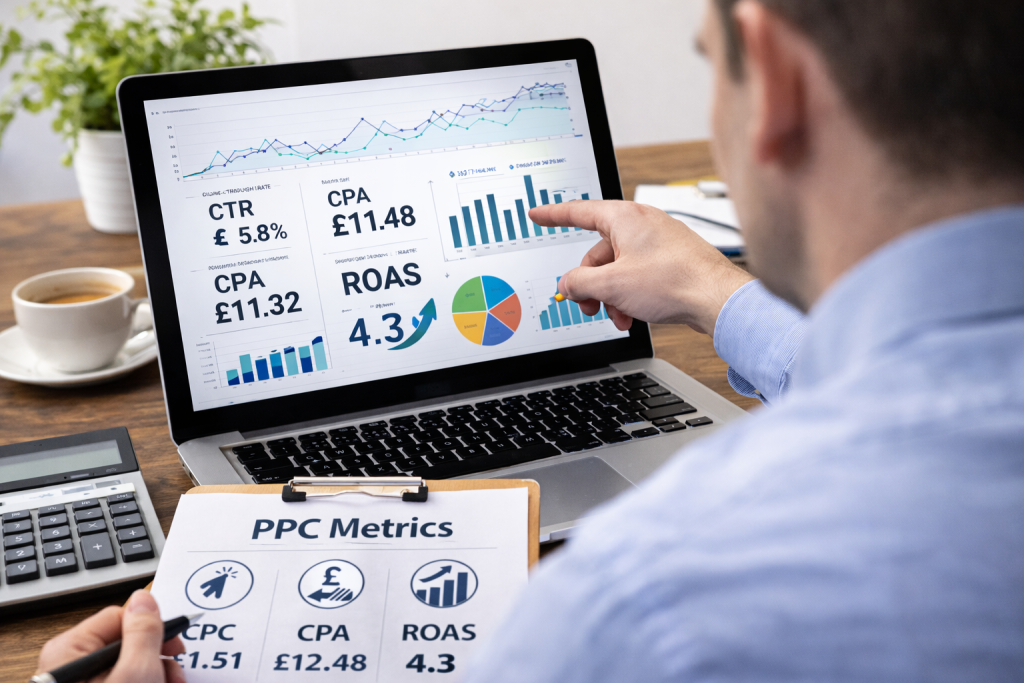
PPC success isn’t about guesswork; it’s about clarity, testing, and continuous improvement. By tracking key PPC metrics like CTR, CPC, CPA, ROAS, and Impression Share, marketers can identify what’s working, fix what’s not, and scale campaigns with confidence.
The best paid media metrics are those that align closely with your business objectives and provide meaningful data to support decision-making. When your tracking strategy is built around clear goals, every optimisation has a direct impact on performance.
As you launch new campaigns, keep a close eye on the metrics discussed here and make adjustments in real time to improve results while the investment is still live.
When you understand the story behind the numbers, every marketing pound goes further. Start tracking smarter today, and your PPC performance will follow.
Ready to Grow Your PPC Results with Arise?
If you’re ready to turn data into growth, our PPC team at Arise is here to help. From campaign setup and ongoing optimisation to full-funnel strategy and cross-channel execution, we’ll work with you to maximise performance and ROI. Let’s talk about your next campaign.