Most businesses investing in SEO focus on the visible elements: the content on the page, the keywords they are targeting, the links pointing to their site. Schema markup sits quietly behind all of that, invisible to users but increasingly significant for how search engines understand and present your content.
Getting schema markup right will not transform a weak site into a strong one. But on a site that already has solid foundations, it is one of the most direct technical levers available for improving how your pages appear in search results, increasing click-through rates and, increasingly, influencing how AI-powered search experiences understand your business. As part of a well-rounded SEO strategy, it is a component that is too often left incomplete.
What Is Schema Markup?
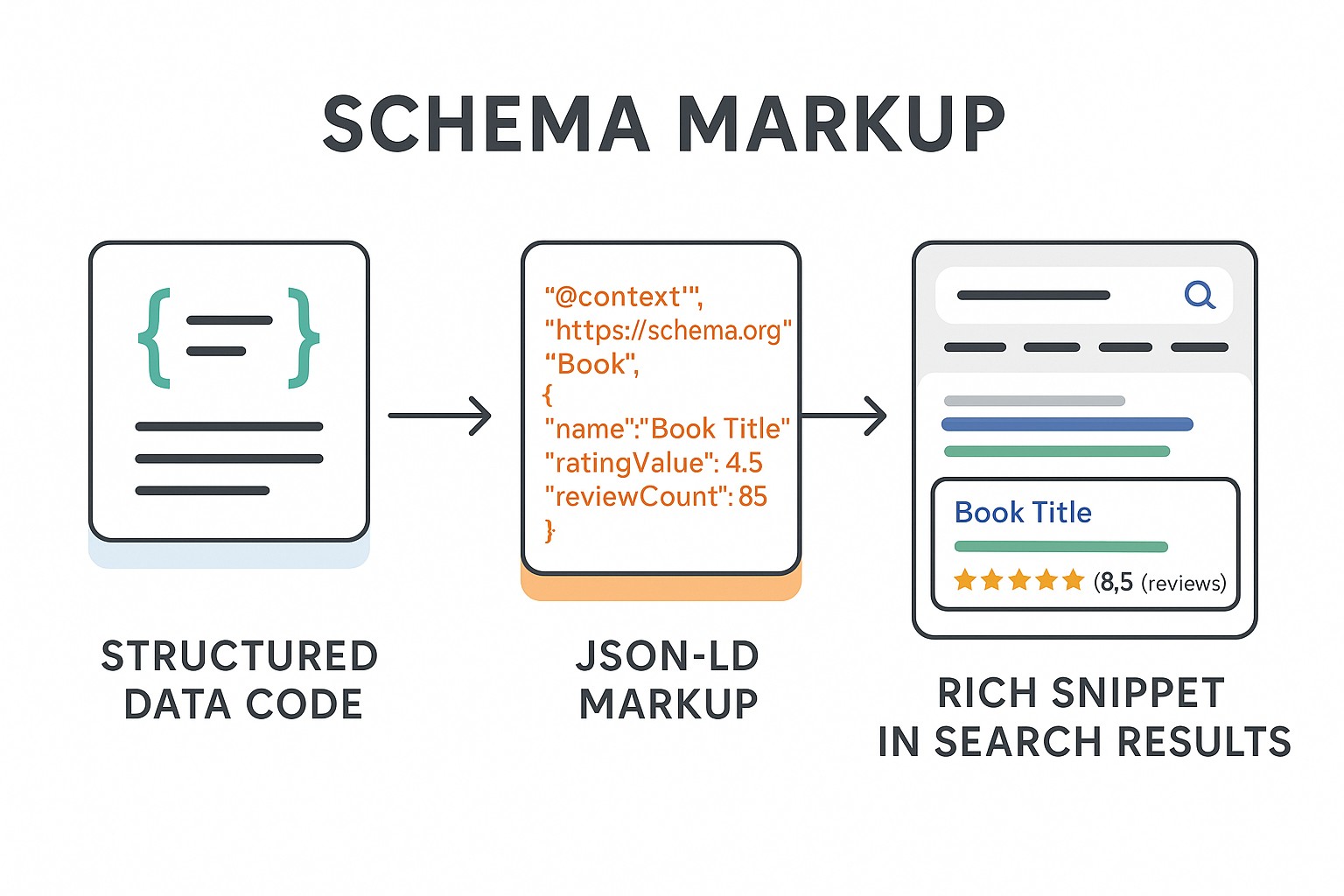
Schema markup is a form of structured data: code added to the HTML of a web page that explicitly tells search engines what the content on that page means, not just what it says.
Without schema, a search engine crawling your page has to infer the meaning of the content it finds. It sees a date and guesses it is a publication date. It sees a number and tries to determine whether it is a price, a phone number or a rating. Schema removes that guesswork. It labels your content in a standardised vocabulary that search engines are built to read and understand.
That vocabulary is defined at Schema.org, a shared standard created by Google, Microsoft, Yahoo and Bing. When you add schema markup to a page, you are speaking directly to those search engines in a language they have specifically designed to understand.
Schema markup does not change what a page looks like to visitors. It works in the background, adding a layer of machine-readable context that shapes how your content is interpreted, categorised, and in many cases, displayed in search results.

How Schema Markup Works in Search Results
When Google understands your content through schema, it can use that understanding to display richer, more informative results in the SERP.
A standard search result shows a title, a URL and a meta description. A result enhanced by schema markup can show star ratings, prices, availability, event dates, FAQ accordions, product images, review counts and more. These enhanced results are known as rich snippets or rich results, and they take up considerably more visual space in the SERP than a standard blue link.
The practical effect is significant. Research from Google’s own Search Central has shown that pages enhanced with structured data can see substantially higher click-through rates than those without. For example, Rotten Tomatoes saw a 25% higher CTR on pages enhanced with structured data compared to those without. When a user can see at a glance that a result has a 4.8-star rating, that a product is in stock or that a FAQ directly answers their question, they are considerably more likely to click it over a result that offers none of that information.
Schema markup is not a direct ranking factor. Google has confirmed this explicitly. What it does is make your pages eligible for rich results, which improve visibility and CTR, and it strengthens how search engines understand and categorise your content, which supports rankings indirectly. For a fuller picture of how all the components of SEO work together, our guide on what is SEO is worth reading alongside this one.
The SEO Benefits of Schema Markup
The benefits of implementing schema markup correctly fall into three categories: visibility, trust and performance.
Visibility
It is the most immediate benefit. Rich results stand out on the SERP. An FAQ accordion that expands to show three questions and answers occupies several times the vertical space of a standard result. A product listing with a star rating, a price and an availability status gives the user far more reason to click than a plain title and description. In competitive search environments, this visual advantage matters.
Trust
It is a less obvious but equally important benefit. Schema markup helps Google verify the identity and authority of your business by connecting your website to a structured, machine-readable entity. Organisation schema, which tells Google your business name, logo, address and contact details, contributes to how your brand is recognised and represented in knowledge panels and in AI-generated answers. A business whose identity is clearly and consistently defined through structured data is one that search engines can confidently surface.
Performance
It follows from both. Higher CTRs mean more traffic from the same ranking position. Better entity recognition means your content is more likely to be understood correctly, matched to the right queries and cited in the growing range of AI-powered search features that are reshaping how results are presented. As we have outlined in our analysis of Google’s AI optimisation guide, structured data remains a relevant signal within the broader SEO picture, even as the landscape shifts.
For a broader understanding of how to track whether these efforts are delivering results, our post on key SEO metrics explained covers the indicators worth monitoring.

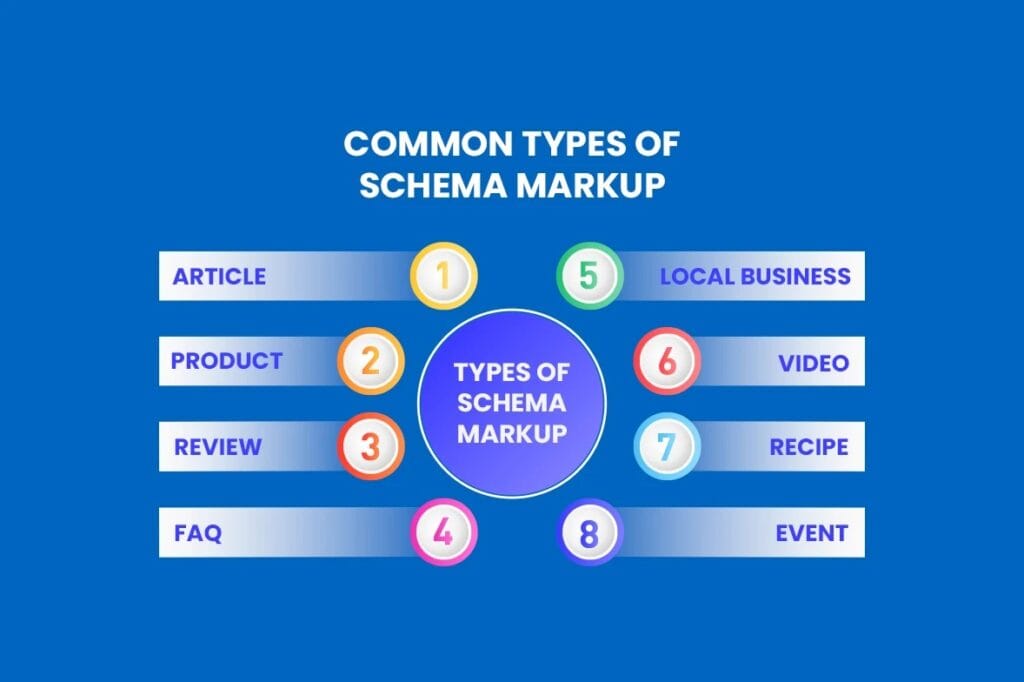
The Most Important Schema Types for Your Website
There are hundreds of schema types defined at Schema.org, but for most business websites, a small number of well-implemented types deliver the majority of the value.
Organisation schema
Placed on your homepage and contact page, tells search engines who you are: your name, logo, address, phone number, founding date and social profiles. This is the foundation of entity recognition and is the single most important schema type for any business website.
Local Business schema
It is a more specific version of Organisation, designed for businesses that serve a geographic area. It includes geo-coordinates, opening hours and service area, and it feeds directly into Google’s local pack and map results. For businesses with a physical presence or a defined service area, this is essential. Our local SEO services incorporate LocalBusiness schema as a standard component of local optimisation.
Article and Blog Posting schema
Applied to editorial content, tell Google the author, publication date, modified date and primary topic of each post. This supports inclusion in Top Stories and helps AI systems correctly classify and cite your content.
FAQ Page schema
Applied to pages with genuine question and answer content, can trigger FAQ accordions in search results that significantly expand your SERP real estate. Note that Google tightened FAQ Page eligibility in its March 2026 core update: this schema is now primarily effective on authoritative, established sites with genuinely useful Q&A content, not as a blanket addition to every page.
Product schema
It is essential for any business selling online to display price, availability, ratings and more directly in the SERP.
Bread crumb List schema
Applied sitewide, replaces the URL in search results with a clean navigational trail and signals your site’s hierarchy to crawlers. It is low-effort and high-return for almost every website.
Schema Markup and AI Search: What You Need to Know
The relationship between schema markup and AI-powered search has been one of the most debated topics in SEO over the past year, and it is worth addressing honestly.
Google has confirmed that there is no special schema markup required to appear in AI Overviews or AI Mode. Structured data is not a direct lever for AI feature inclusion in the way that some commentators have claimed. What Google’s guidance does confirm is that structured data remains a useful part of an overall SEO strategy, and that it helps search engines understand content accurately, which supports visibility across both traditional and AI-powered results.
What the evidence does support is that schema markup contributes to entity clarity: the ability of AI systems to identify your business, understand what it does, and assess whether your content is a credible source for a given query. A 2025 controlled experiment cited by Search Engine Land found that a page with well-implemented schema ranked higher and appeared in AI Overviews, while an identical page with no schema was not even indexed. That is not proof that schema drives AI inclusion directly, but it is a meaningful signal about the role of technical completeness in search performance overall.
The honest position, which aligns with our own analysis of Google’s AI guidance, is that schema markup is part of the technical foundation that allows everything else to work properly. It is not a shortcut to AI visibility, but a technically sound site without it is operating at a disadvantage.
How to Add Schema Markup to Your Website
There are several ways to implement schema markup, depending on your CMS and technical setup.
JSON-LD
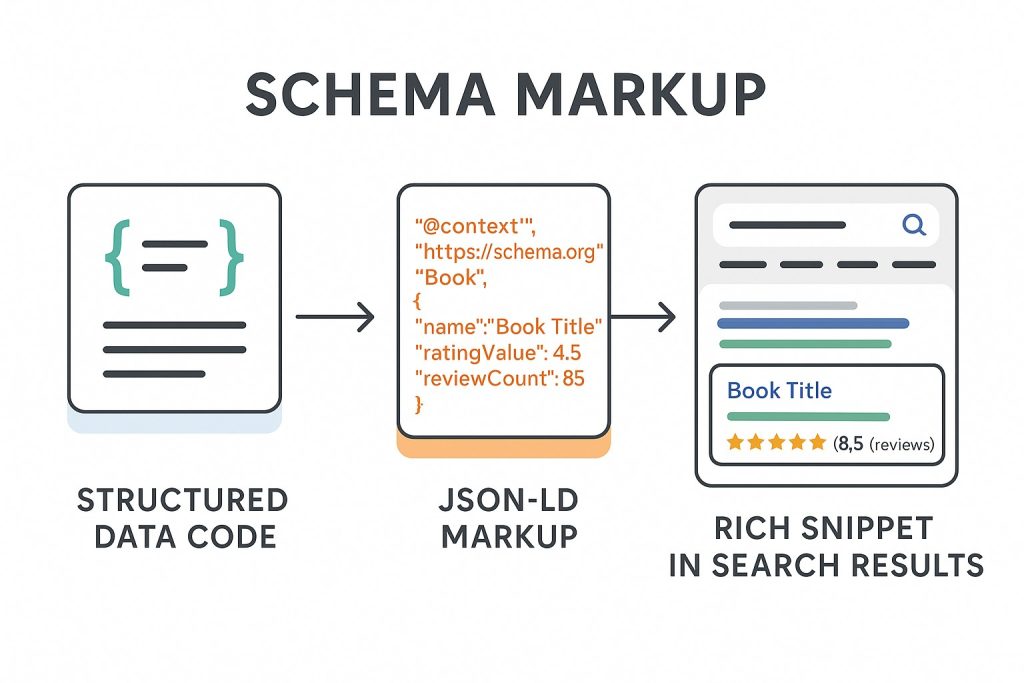
It is Google’s recommended format and the only one worth using in most cases. It is a block of structured code placed in the <head> section of your page HTML. It is completely separate from the visible content, which means it can be updated without touching the page design.
WordPress plugins
Plugins such as Rank Math and Yoast SEO can generate and insert schema automatically based on your site’s content and settings. Rank Math in particular offers a Schema Generator that supports a wide range of types including Article, FAQ, Product and LocalBusiness. These tools are the most practical option for most WordPress sites, though the output should always be validated.
Manual implementation
It gives you the most control and is the right approach for complex or custom requirements, such as nested schema types or implementation via a headless CMS.
Whichever method you use, always validate your implementation using Google’s Rich Results Test and Schema.org’s Validator before publishing. An invalid schema is worse than no schema: it can result in a manual action from Google that makes the page ineligible for rich results entirely.
If your site runs on WordPress, our WordPress SEO services include schema implementation as part of the technical optimisation work we carry out for clients.
Common Schema Markup Mistakes to Avoid
The most common schema mistakes tend to fall into a small number of consistent patterns.
Implementing a schema that does not match the page content
It is the most fundamental error. Google requires that structured data accurately represent what is visible on the page. A schema on a page that does not contain the content it describes will be ignored or, in repeated cases, penalised.
Applying the FAQ Page schema to every page indiscriminately
It is a mistake that became widespread when FAQ accordions were regularly triggering in search results. Google’s March 2026 update significantly reduced FAQPage rich result eligibility for sites that had applied the schema without genuine Q&A content. Only pages with real, helpful questions and answers should carry the FAQ Page schema.
Failing to validate before publishing
It allows errors to reach live pages undetected. Even small formatting issues in JSON-LD can break the schema entirely. Always run the Rich Results Test before and after implementation.
Setting and forgetting
It is a common oversight. Schema markup needs to be maintained. If prices, opening hours, product availability or other time-sensitive data changes on your site without the corresponding schema being updated, the discrepancy will be picked up and may affect your rich result eligibility.
Using the wrong schema type
The content in question produces a schema that either does nothing or actively misleads. If your content is a service page, use the Service schema. If it is a blog post, use BlogPosting. The more specific and accurate the schema type, the more value it provides.
How Schema Markup Fits Into Your Technical SEO Strategy
Schema markup is one component of a broader technical SEO strategy, and understanding its place within that broader picture matters.
Technical SEO addresses the infrastructure of your website: crawlability, indexation, site speed, architecture and structured data. Each of these elements contributes to how effectively search engines can access, understand and rank your content. Schema markup specifically addresses the understanding dimension, providing the machine-readable context that helps search engines correctly categorise and display your pages.
A site with excellent schema implementation but fundamental crawl or indexation issues will still underperform. The technical foundation needs to be sound before the more granular optimisations, including schema, can deliver their full value. This is why our approach to technical SEO begins with a thorough audit of the site’s infrastructure before addressing specific elements like structured data.
Schema markup also intersects with LLM optimisation. As AI-powered search tools become a larger part of how users discover content, the clarity of your site’s structured data contributes to how those systems understand and reference your business. Our LLM optimisation service addresses this specifically, working alongside technical SEO to strengthen your visibility across both traditional and AI-driven search.
For a comprehensive view of how technical SEO, content strategy and authority building work together over time, our guide on how to build a sustainable long-term SEO strategy covers the full picture.
Schema Markup – FAQs
What is schema markup in SEO?
Schema markup is structured data code added to a web page’s HTML that tells search engines what the content means, not just what it says. It uses the Schema.org vocabulary to label elements like products, reviews, events, business details and FAQs in a format search engines can directly understand.
Does schema markup improve rankings?
Schema markup is not a direct ranking factor. Google has confirmed this. What it does is make pages eligible for rich results, which typically generate higher click-through rates, and it strengthens how search engines understand and categorise your content, which supports performance indirectly.
What is the best schema markup format?
JSON-LD is Google’s recommended format and the standard used by professional SEO practitioners. It is inserted into the <head> section of the page HTML, separate from the visible content, which makes it easier to implement and maintain.
How do I know if my schema markup is working?
Use Google’s Rich Results Test to validate your implementation and check eligibility for rich results. Google Search Console also shows which pages have structured data errors or warnings under the Enhancements section.
Is schema markup relevant for local businesses?
Yes. LocalBusiness schema is one of the most valuable schema types for businesses with a physical location or a defined service area. It feeds directly into Google’s local pack and map results. If local visibility is a priority, implementing LocalBusiness schema correctly is an important part of your local SEO strategy.
Should I implement schema markup myself or use an agency?
Simple schema types like Organisation and BlogPosting can be implemented via WordPress plugins without technical knowledge. More complex implementations, including nested schema, custom CMS setups or sites with significant structured data errors, benefit from specialist input. If you are unsure where your site currently stands, a free SEO audit is a practical starting point.