Breadcrumbs are one of those SEO elements that most people set up once, rarely think about again, and consistently underestimate. They appear on almost every well-structured website, they influence how search engines understand your content, and since Google’s 2025 update changed how they appear in search results, they have been widely misunderstood.
This guide covers what breadcrumbs actually are, why they still matter for technical SEO, what Google’s changes actually mean for your site, and how to implement them correctly using JSON-LD schema. Whether you are new to the concept or looking to make sure your existing implementation is right, this is the complete picture.
What Are SEO Breadcrumbs?
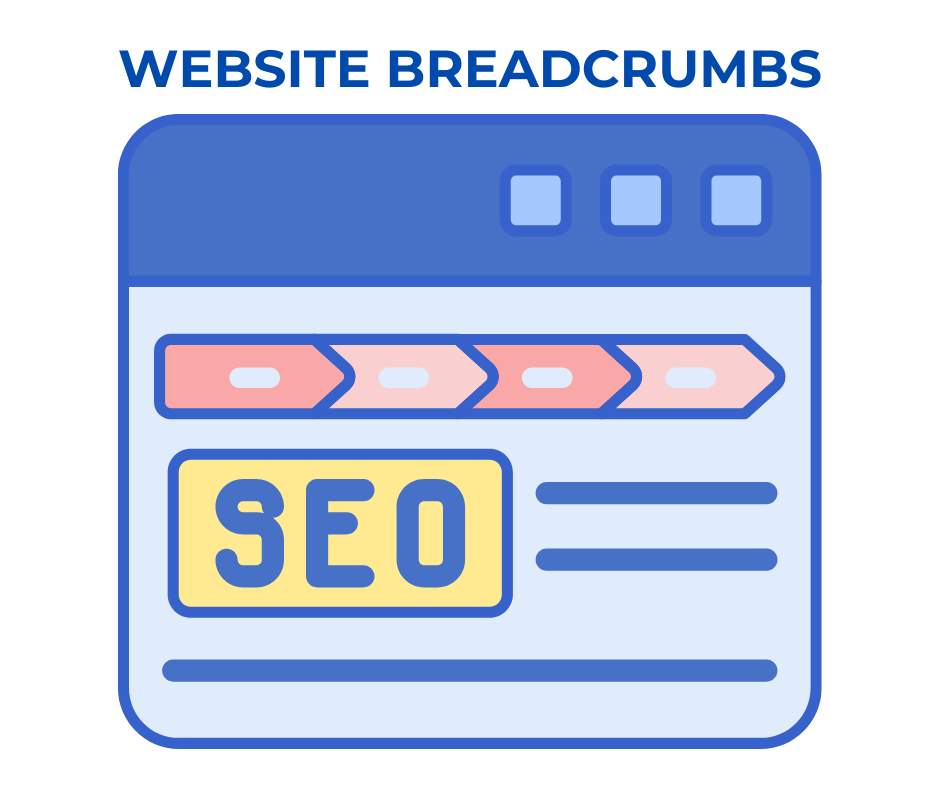
Breadcrumbs are a secondary navigation system that shows a user where they are within a website’s hierarchy. They typically appear near the top of a page, just below the main navigation, and display a clickable trail of links from the homepage to the current page.
A typical breadcrumb trail looks like this:
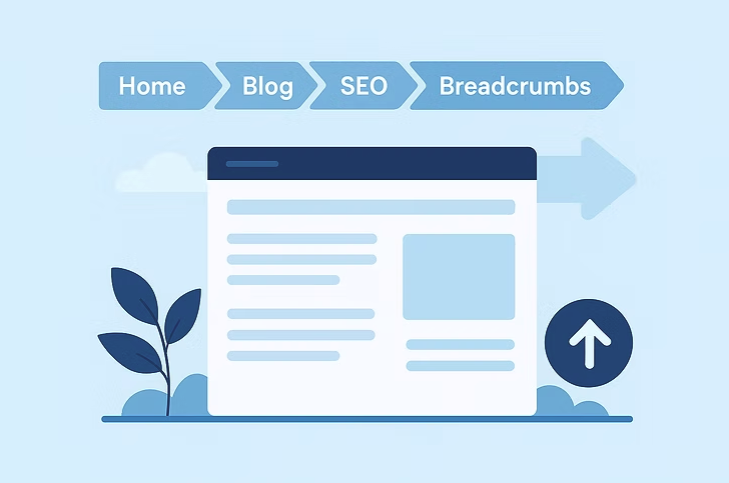
Home > Blog > SEO > Breadcrumbs in SEO
Each element in that trail is a real, clickable link. A user who landed on this page from a search result can click “SEO” to browse other SEO articles, or “Blog” to see all content, without having to use the browser back button or return to the homepage.
The name comes from the Hansel and Gretel fairy tale, where the children left a trail of breadcrumbs to find their way home. In web design, breadcrumbs serve the same purpose: they help users retrace their steps and orient themselves within a site’s structure.
What makes breadcrumbs relevant to SEO is that they do two things simultaneously. They serve users with a clear navigation path. And they serve search engines with a machine-readable map of how your pages relate to each other, which is where the SEO value lies.
The Three Types of Breadcrumbs and When to Use Each
Not all breadcrumbs are the same. There are three main types, each suited to different site structures and use cases.
Hierarchy-based Breadcrumbs
Hierarchy-based breadcrumbs are the most common and the most useful for SEO. They show where a page sits within the site’s permanent structure, regardless of how the user arrived there. A blog post about breadcrumbs in SEO might show: Home > Blog > SEO > Breadcrumbs in SEO. This type creates consistent, stable internal links that pass link equity upward through the site hierarchy and give search engines a reliable map of your content structure. For most websites, this is the right choice.
Attribute-based Breadcrumbs
Attribute-based breadcrumbs are used primarily in e-commerce and filter-heavy sites. Instead of showing a fixed hierarchy, they reflect the attributes a user has selected: Home > Shoes > Women’s > Running > Size 7. These are useful for guiding users through product filtering, but they require careful implementation to avoid creating inconsistent internal linking signals. If the breadcrumb changes dynamically depending on how a user navigated to the page, the internal linking benefit is significantly reduced.
History-based Breadcrumbs
History-based breadcrumbs show the path a specific user took to reach the current page, effectively replicating browser history as a navigation element. These provide no SEO value and are not recommended in any professional implementation. Every user’s path is different, which means the breadcrumb trail changes for every visitor, producing no consistent internal linking structure and confusing crawlers rather than helping them.
For the vast majority of sites, hierarchy-based breadcrumbs are the correct choice.
Why Breadcrumbs Still Matter for SEO
When Google removed breadcrumbs from mobile search results in January 2025, a significant number of SEOs concluded that breadcrumbs no longer mattered. That conclusion is wrong, and it is worth being clear about why.
The display of breadcrumbs in search results was one function of the breadcrumb system. The more fundamental functions, internal linking, crawl efficiency, site hierarchy signalling and structured data for AI systems, are entirely separate and remain fully intact.
Internal Linking
Every breadcrumb is a real internal link. A site with thousands of product or content pages benefits from thousands of contextual internal links flowing upward through the hierarchy automatically. This distributes link equity from deep pages back to category and parent pages, reinforcing their authority and relevance. This function has nothing to do with how breadcrumbs appear in search results.
Crawl Efficiency
Breadcrumbs create additional pathways for crawlers to discover and revisit pages. On large sites, where crawl budget is a genuine consideration, a well-implemented breadcrumb structure means crawlers can navigate the site more efficiently and index deeper pages more reliably.
Site Hierarchy Signalling
When Google sees a consistent breadcrumb pattern across a site, it builds a clearer understanding of how the content is organised and how different pages relate to each other. This supports entity-based understanding of your site’s topic coverage, which matters for how your content is ranked and recommended.
AI Search Systems
This is the dimension that most guides still overlook. When an LLM or AI search system encounters the path Home > Marketing > SEO > Technical SEO > Breadcrumbs, it constructs a semantic map that positions “Breadcrumbs” as a subset of “Technical SEO,” which belongs within “SEO,” which belongs within “Marketing.”
This entity mapping is how generative AI systems understand what a page is about beyond keywords. Sites with clear, consistent breadcrumb structures are easier for AI to categorise, cite and surface in structured answers. As we have covered in our guide to Google’s AI optimisation guidance, structured data is an increasingly important signal for AI-driven search visibility.

Google Removed Breadcrumbs from Search Results: What Actually Changed
In January 2025, Google removed breadcrumb navigation from mobile search results. Desktop search results continued to display breadcrumbs. Google’s own statement was direct: the breadcrumb element was being removed from mobile because it was not as useful to mobile searchers, as it gets cut off on smaller screens.
This is a display change, not a structural one. The BreadcrumbList schema markup still works. Google still reads and processes it. The internal linking and hierarchy signals breadcrumbs provide still influence how the site is crawled and understood. What changed is that mobile users no longer see the breadcrumb trail in the search result snippet itself.
The practical implication for site owners is modest. If your click-through rate from mobile search was influenced by the breadcrumb path visible in the SERP, that signal is gone and the URL is displayed instead. This makes optimised meta titles and meta descriptions more important for mobile CTR than they were before.
What has not changed: everything that makes breadcrumbs valuable for SEO beyond their appearance in search results. If you were implementing breadcrumbs correctly, there is nothing to fix. If you were not, the reasons to implement them now are exactly what they were before the January 2025 update.
How Breadcrumbs Help Search Engines and AI Understand Your Site
The relationship between breadcrumbs and search engine understanding operates at two levels: the link level and the semantic level.
At the link level, every breadcrumb is an anchor text link pointing from a deep page to a parent page. The anchor text of that link, for example “Technical SEO” in a breadcrumb pointing back to the technical SEO category page, is a keyword signal that reinforces what the parent page is about. Multiply this across hundreds or thousands of pages and the cumulative keyword signal flowing to category pages becomes significant.
At the semantic level, the breadcrumb structure communicates how your content is organised as a whole. Google’s entity-based indexing does not evaluate pages in isolation. It analyses how content relates within the broader context of a site. When breadcrumbs consistently show that certain pages sit within certain categories, which sit within certain sections, the algorithm builds a stronger topical association between your site and those subjects.
For AI systems, this entity mapping is even more explicit. The BreadcrumbList schema tells AI crawlers not just that a page exists, but where it sits in the knowledge structure of your site. This positioning influences whether AI systems are confident enough in the relevance and authority of your content to cite or surface it in generated answers.
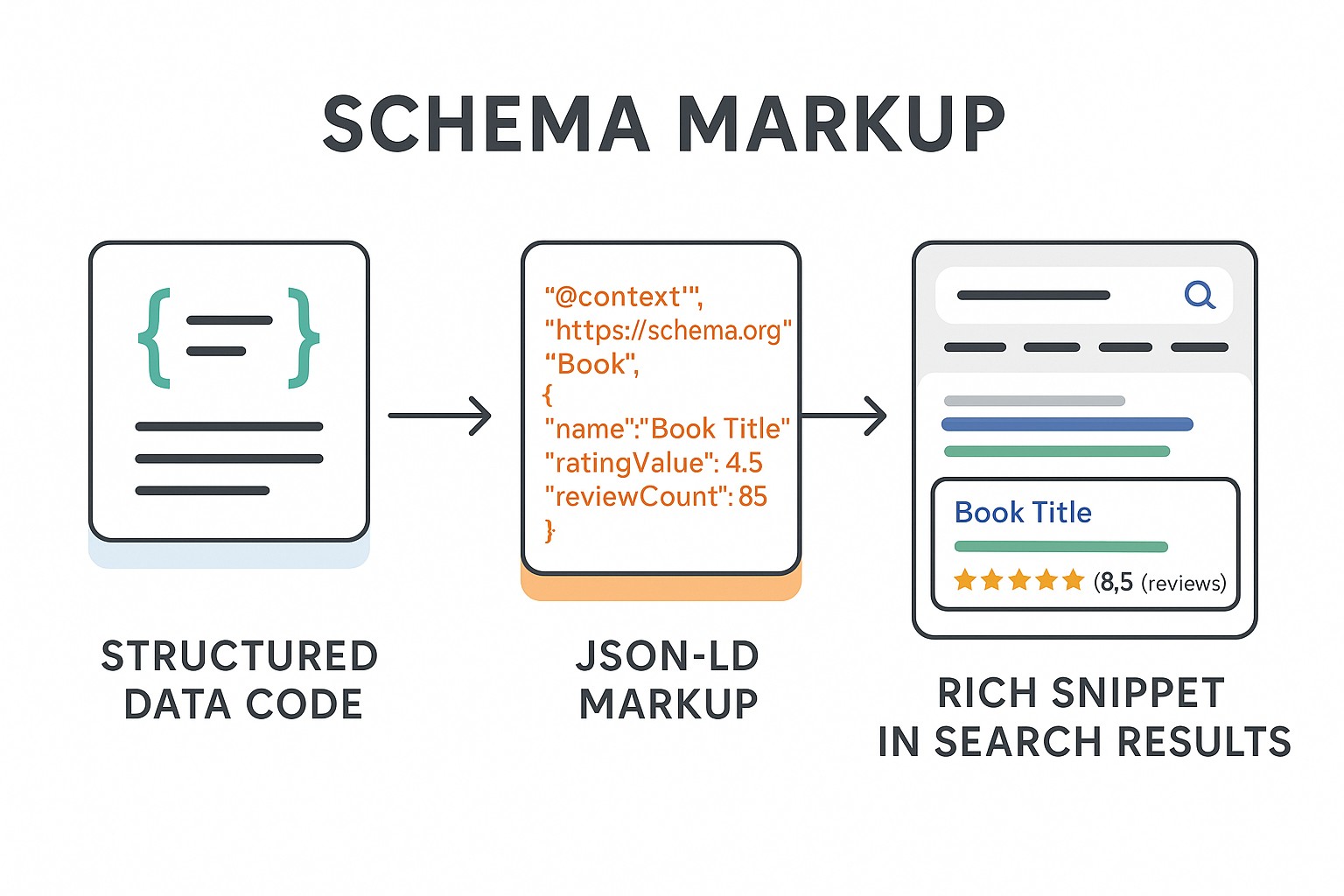
For a broader view of how structured data contributes to both traditional and AI-driven search visibility, our guide on schema markup and SEO covers the full picture.
How to Implement Breadcrumbs: JSON-LD Schema Code
There are three ways to implement breadcrumbs: visually in HTML, via a WordPress plugin, or using JSON-LD structured data. For SEO purposes, JSON-LD is Google’s recommended format and the one that provides the clearest signal to search engines and AI systems.
The visual breadcrumb, the trail users see on the page, and the schema breadcrumb, the structured data code that search engines read, should always match. If they show different hierarchies, you are sending conflicting signals.
Here is a standard JSON-LD BreadcrumbList implementation:
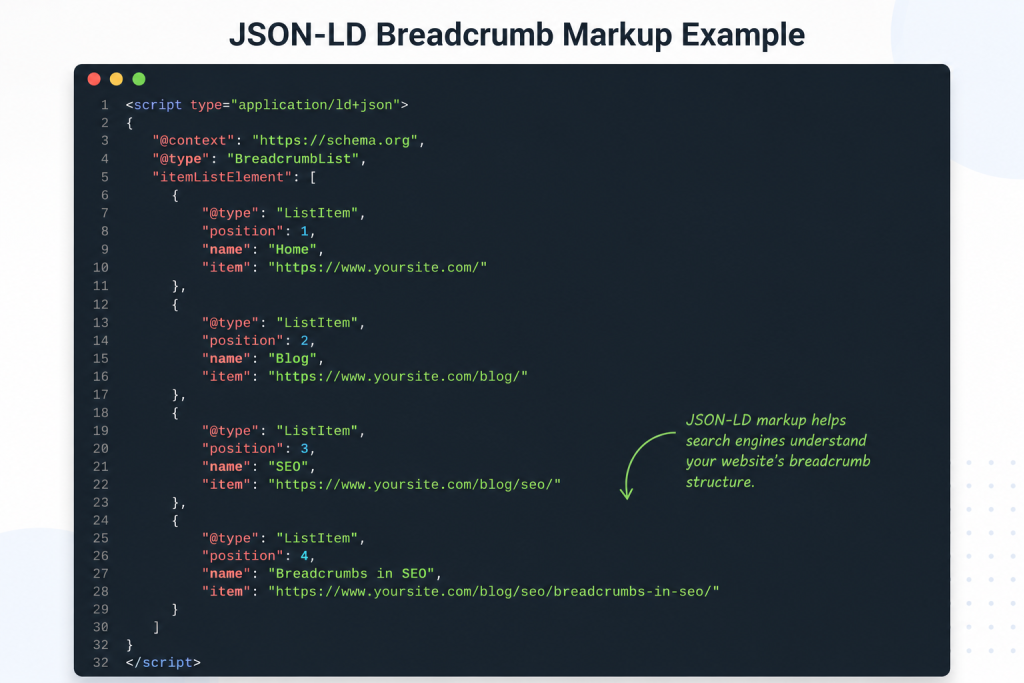
Each ListItem represents one level of the hierarchy, with position indicating its place in the trail, name providing the label, and item providing the URL. The most common implementation error is leaving the item field empty or malformed. Google’s Rich Results Test will flag this as a “Missing field ‘item'” error, which breaks the schema chain for crawlers.
For WordPress sites, plugins such as Yoast SEO and Rank Math generate BreadcrumbList schema automatically based on your site’s category and page structure. The output should always be validated using the Rich Results Test before and after any significant site structure changes.
Breadcrumb Best Practices: What to Get Right
A technically valid breadcrumb implementation is necessary but not sufficient. The following practices determine whether your breadcrumbs actually deliver SEO value.
Match the Visual and Schema Breadcrumbs
The trail users see on the page should match the trail in your JSON-LD. Mismatches confuse crawlers and undermine the hierarchy signal.
Use Descriptive Anchor Text
“Running Shoes” is a better breadcrumb label than “Shoes” if the category genuinely covers running shoes. The anchor text acts as a keyword signal for the parent page. Use it meaningfully, not generically.
Keep the Hierarchy Consistent
Every page of the same type should follow the same breadcrumb structure. Inconsistent patterns, where the same page appears under different parent categories in different breadcrumbs, create conflicting signals.
Start from the Homepage
Every breadcrumb trail should begin at Home and follow the full hierarchy to the current page. Truncated trails that start at a category level miss the link equity flow from deep pages back to the top of the site.
Make Every Element Clickable
A breadcrumb where only some elements are links, or where the current page is linked to itself, is both a user experience failure and a wasted SEO opportunity. The final element (the current page) should not be a link. All preceding elements should be.
Align with Your URL Structure
If your breadcrumb shows Home > Blog > SEO but your URL is /articles/seo-category/, you are signalling a structure that does not exist. Search engines notice this misalignment and it undermines the credibility of both the breadcrumb and the URL.
When You Do Not Need Breadcrumbs
Breadcrumbs are not universally appropriate, and implementing them on sites where they add no value is pointless overhead.
Single-level sites, where all content pages sit directly below the homepage with no intermediate categories, have no hierarchy for breadcrumbs to express. A simple portfolio site, a single-service landing page or a brochure site with five pages does not need breadcrumbs.
Flat architecture sites where all pages are at the same level offer no parent-child relationships for a breadcrumb to navigate. If there is no hierarchy, a breadcrumb trail cannot represent one.
Linear user journey pages, such as checkout flows, multi-step forms or onboarding sequences, should not carry hierarchy-based breadcrumbs. These pages are designed to guide users through a specific sequence, and introducing a breadcrumb that points back to a category or homepage creates an unnecessary exit point.
The threshold at which breadcrumbs become valuable is approximately three levels of hierarchy. Home → Category → Page is the minimum structure that justifies a breadcrumb implementation.
How Breadcrumbs Fit Into Your Technical SEO Strategy
Breadcrumbs are one component of a broader technical SEO strategy, and understanding their place within that whole matters.
Technical SEO addresses the infrastructure of a website: how it is crawled, how it is indexed, how its pages are structured and how search engines understand the relationships between those pages. Breadcrumbs specifically address the structure and relationship dimension. They are not a substitute for solid crawlability, correct indexation or page speed, but they contribute meaningfully to all of these by creating efficient crawl pathways, distributing link equity logically and signalling site hierarchy clearly.
The most effective approach is to audit breadcrumb implementation as part of a full technical SEO audit rather than in isolation. Check that the visual breadcrumbs and schema breadcrumbs match, that the hierarchy reflected in breadcrumbs aligns with the actual URL structure, and that the BreadcrumbList schema is free of errors in Google Search Console’s Enhancements report.
For sites using WordPress, our WordPress SEO services include breadcrumb implementation and validation as part of the technical optimisation work we carry out for clients.
As AI-driven search continues to grow in importance, the structured data layer that breadcrumbs contribute to becomes more rather than less significant. AI systems use entity relationships to understand and categorise content. A site with clear, consistent breadcrumb structures and matching schema is better positioned for AI citation and visibility than one without. Our LLM optimisation service addresses this dimension specifically, working alongside technical SEO to strengthen visibility across both traditional and AI-driven search.
For further reading on breadcrumb implementation standards, Google’s Search Central documentation on breadcrumbs is the authoritative reference.
Frequently Asked Questions About Breadcrumbs in SEO
What are breadcrumbs in SEO?
Breadcrumbs in SEO are a secondary navigation system that shows users and search engines where a page sits within a website’s hierarchy. They appear as a clickable trail of links, typically Home > Category > Subcategory > Page, and provide both a user navigation aid and a structured signal to crawlers about site structure and internal linking.
Do breadcrumbs still matter after Google’s 2025 update?
Yes. Google’s January 2025 update removed breadcrumbs from mobile search result snippets, but this was a display change only. The internal linking, crawl efficiency, site hierarchy signalling and structured data value of breadcrumbs are entirely unaffected. Desktop search results continue to display breadcrumbs, and the BreadcrumbList schema continues to be processed by Google and AI search systems.
What is the best way to implement breadcrumbs for SEO?
The most effective implementation uses JSON-LD BreadcrumbList structured data, which is Google’s recommended format. The visual breadcrumb trail on the page and the JSON-LD schema should match exactly. Every element of the trail should be a clickable link except the current page. The hierarchy shown should align with the actual URL structure of the site. Implementation should be validated using Google’s Rich Results Test.
Which websites benefit most from breadcrumbs?
Sites with three or more levels of hierarchy benefit most from breadcrumbs. This includes e-commerce sites with product categories, content sites with topic categories and subcategories, news sites, SaaS sites with multiple product sections and documentation portals. Single-level sites, flat architectures and sites with fewer than ten pages do not need breadcrumbs.
Can breadcrumbs help with AI search visibility?
Yes. AI search systems including Google AI Overviews, ChatGPT and Perplexity use entity relationship data to understand and categorise content. Breadcrumbs, particularly when implemented with BreadcrumbList schema, provide explicit entity mapping that positions each page within a semantic hierarchy. Sites with clear, consistent breadcrumb structures are easier for AI systems to categorise and more likely to be cited in structured AI-generated answers.